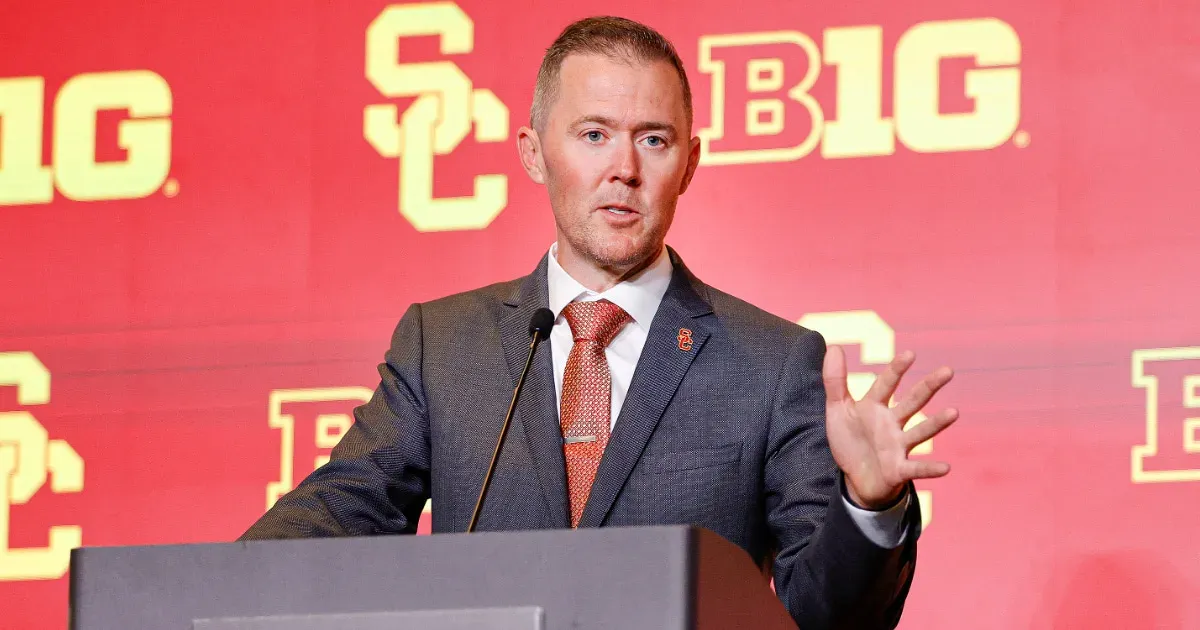
USC head coach Lincoln Riley used his appearance at Big Ten Media Days in Chicago on Tuesday to publicly back the introduction of a genuine salary cap in college sports. He argued it would bring greater stability to a landscape still adjusting to the NIL era.
Speaking to reporters at the Hilton Chicago, Riley acknowledged that conditions have improved since the chaotic early years of NIL. Per On3 via Yahoo Sports, he said the environment has normalised considerably, though he was careful to distinguish that from being truly normal. A hard salary cap, he argued, would push things further in the right direction.
The backdrop is the House settlement. It came into effect last year and allows schools to share revenue directly with athletes up to a set cap. That cap does not cover third-party NIL deals, and overall roster expenditure in college football continues to climb.
Why Riley Sees a Cap as the Fix
Riley framed his position around competitive fairness rather than cost-cutting. He told reporters he has no desire to hold a major spending advantage over rivals, but equally has no interest in being at a significant disadvantage when competing for a championship. His core argument was that a salary cap would lock in the stability that has already begun to emerge naturally.
He was not, however, claiming it is a simple fix.
The Enforcement Problem
Riley pointed directly to litigation as the main obstacle. According to On3, he said any cap mechanism must be enforceable in state courts across the country — exactly where current NCAA rules have struggled to hold up. He drew a comparison to the NFL’s collective bargaining structure, noting that college football faces distinct complications because programmes are tied to universities rather than operating as standalone professional franchises. Without a legal framework that can withstand court challenges, a cap risks being dismantled before it takes effect.
Courts have killed these rules before.
The NCAA is currently working to secure the Protect College Sports Act, which supporters hope would provide a clearer federal basis for enforcing eligibility and financial rules.
Pressure on Riley Heading Into 2026
Riley’s policy comments came alongside broader scrutiny of USC’s on-field trajectory. A column published Tuesday by Trojans Wire, cited by FishDuck, argued that USC has run out of excuses and must start beating Oregon to change the West Coast pecking order. The piece pointed to Dan Lanning’s 48-6 overall record at Oregon — including an unbeaten Big Ten championship season in 2024 and a run to the national semifinals in 2025 — as evidence that the Ducks have become the regional benchmark.
That record is hard to argue with. USC’s 2026 season presents Riley with the clearest opportunity yet to answer that pressure on the field.